English
When our pupils leave Fleecefield, we expect them to be able to be confident and fluent communicators through speaking and listening, reading and writing.
We expect this because we know that good communication skills will open up a wide range of opportunities for them within and beyond their local community.
Phonics
What is phonics?
Phonics is simply the system of relationships between letters and sounds in a language. When your child learns that the letter A has the sound of ‘a’ or your older child learns that “tion” sounds like ‘shun’, they are learning phonics.
At Fleecefield Primary School we use the 'Read Write Inc.' phonics programme.
Why is phonics important?
Learning phonics will help your child learn to read and spell. Written language can be compared to a code, so knowing the sounds of letters and letter combinations will help your child decode words as they read. Knowing phonics will also help your child know which letters to use as they write words.
Play the below video for information on phonics and how to practice the sounds with your children.
http://www.oxfordowl.co.uk/pages/phonics-made-easy
Phonics at Fleecefield
At Fleecefield, we are passionate about reading and share the ethos of ‘every child a reader’. As a school, reading is one of our highest priorities. Reading is the foundation of all learning and one of the most important skills a child will learn during their early years of development. This skill will not only improve your child’s future prospects but will also allow them to be lifelong, independent learners. This is the expectation of all of our children on their educational journey at Fleecefield.
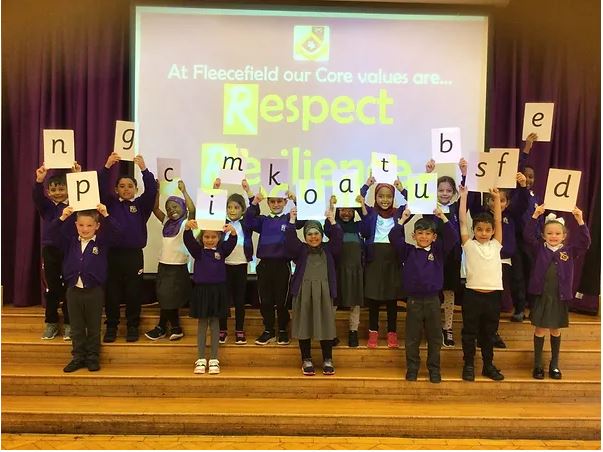
We use the Read Write Inc. phonics programme to teach our children to read. Teaching starts in Nursery and continues into Key Stage 1. Read Write Inc. is a systematic way of teaching phonics. Your child is assessed every 6-8 weeks to ensure they make rapid progress and some children receive one-to-one to tuition.
READ WRITE INC.
In Early Years and Key Stage 1 we use the Read Write Inc scheme to assist in the teaching of phonics.
Have a look on http://www.ruthmiskin.com/en/parents for more information.
Click here to read correspondence explaining how the Read Write Inc scheme works.
Click here to see frequently asked questions and answers that might help your understanding.
Below you will also see links to videos that will help you better understand Read Write Inc.
Reading
Reading
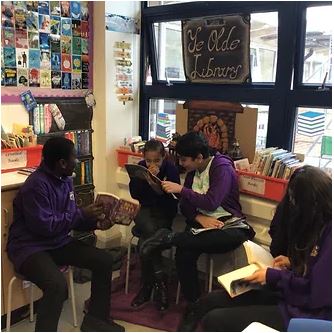
Reading is a priority at Fleecefield; we expect every child to be a reader. We start by providing children with a wide variety of books that promote enthusiasm and encourage a love of reading, as we know that when children enjoy reading, this will have a huge impact on their success throughout the curriculum. Teachers share books through regular story times, which provide pupils with opportunities to experience a wide range of texts; engaging book talk; introduction of new vocabulary; and open up a whole world of background knowledge they can apply to their learning. We also have a strong emphasis on developing pupils’ vocabulary, which is reinforced during reading lessons and throughout the curriculum.
EYFS
At the start of their journey, children learn to decode using the Read Write Inc synthetic phonics scheme (further information is available on our web page) and develop inference skills using the CLPE’s Power of Reading strategy. Alongside developing sound reading strategies, we also emphasise developing quality talk.
KS1
Children continue on their phonics journey, complemented by the Power of Reading strategy and texts. Each book is used over two or three weeks, building up as the story is slowly revealed. Teachers use a range of teaching strategies to stimulate book talk and role play. Pupils are also encouraged to engage with the stories independently through a range of available resources. Questioning is used to develop the pupil’s inference skills, and this also leads to a range of writing outcomes.
KS2
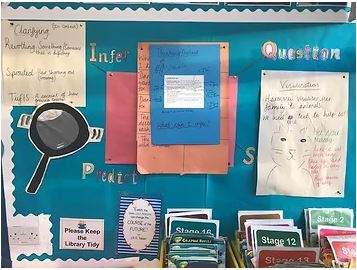
In KS2, we explicitly teach inference strategies through weekly discrete, domain-driven reading lessons. Pupils also have a core text each term that has been chosen to complement the curriculum and offer a diverse reading experience across the year. Teaching has a strong emphasis on improving children’s ability in areas such as prediction, visualising, summarising, and developing fluency and vocabulary so that children can make more complex inferences as they progress through the school.
Home Reading
At Fleecefield, the partnership between home and school is integral to our pupil’s progress, so we expect all pupils to read at home every day.
Children bring home age- and stage-appropriate books each day, and parents have the opportunity to spend time with their children listening to them read. Our pupils also have access to a wide range of vocabulary games, visual stories, reading strategy revision and books, lots of books (including Oxford Owl and bilingual books) through our very own ‘Virtual Library ’, which can be accessed at home through their Google accounts.
-
Please click here to access the list of Year 1 50 Recommended Reads
-
Please click here to access the list of Year 2 50 Recommended Reads
-
Please click here to access the list of Year 3 50 Recommended Reads
-
Please click here to access the list of Year 4 50 Recommended Reads
-
Please click here to access the list of Year 5 50 Recommended Reads
-
Please click here to access the list of Year 6 50 Recommended Reads
Writing
WRITING
At Fleecefield, we believe that all children can achieve and succeed in writing. We have the highest expectations for every pupil and are committed to ensuring that all children develop the skills, knowledge, understanding and confidence needed to become successful writers.
Many of the community we serve experience high levels of socio-economic disadvantage and we have significant numbers of pupils who speak English as an additional language. We believe that these factors should never limit children’s literacy achievement. Through high-quality teaching, ambitious expectations and carefully designed learning experiences, we ensure that all pupils can access, participate and succeed in writing.
Through an ambitious curriculum, high expectations, and a commitment to equity and inclusion, we strive to ensure every pupil experiences success, develops a positive identity as a writer, and leaves our schools well prepared for the next stage of their education.

Curriculum design
We use the national curriculum, the Literary Curriculum, and high-quality texts to form the basis of our writing curriculum.
Grammar teaching is embedded within the planning, and in addition we use ‘Grammar Overview’ documents for each year group to ensure coverage. The expectation is that new grammar is taught discretely, and previously taught grammar is revisited, or retaught as needed until we achieve automaticity.
Teaching and Learning
Teachers explicitly model the craft of writing. We use the 'I do, we do, you do' approach in writing, as across our curriculum, to ensure teachers actively instruct, model, and refine children's skills before expecting independent mastery. Pupils practice through a balance of short-burst writing (to hone specific skills) and extended writing pieces (to apply those skills with fluency).
To ensure consistency and quality of teaching, we have five ‘Key Elements of Writing Lessons’ that all teachers work to:
- The text is used to create engagement and enjoyment, as well as exposure to a range of genres and writing styles
- There is deliberate practice of a new or not yet embedded writing skill (e.g. grammar knowledge/ sentence structuring / punctuation / editing)
- Models (See below) are used to show children what is expected and to demonstrate how to produce a piece of writing
- Children are given time to write independently in every lesson. This can be practising sentences, a short piece of instant publishing or working on a longer piece of writing over a series of lessons
- Scaffolds, for example sentence starters, word banks and visuals, are provided in every lesson to allow the lower attaining pupils to write with independence, and the higher attaining pupils to reach for Greater Depth
Modelling is key to our lessons. Teachers use both ‘pure modelling’ (or ‘I do’, where the teacher articulates their thinking during the writing process) and ‘shared writing’ (where the teacher works with the children to write a sentence/passage) in every lesson to support learning and scaffold independent writing tasks.
Foundational Skills
Technical fluency supports creative expression. Consequently, we teach core skills explicitly:
Spelling: At Fleecefield, we use the No Nonsense Spelling Programme. We teach spelling systematically, focusing on patterns and rules to ensure children build confidence and accuracy.
Handwriting: We teach handwriting explicitly, using the Letter-Join handwriting programme to structure progression across the school so that children develop fluency, speed and automaticity.
Grammar and punctuation: We teach new grammar and punctuation initially in isolation to limit cognitive overload and ensure children have a secure foundational understanding, then teach them in context so they understand how these mechanics empower their writing rather than viewing them as abstract checklists.
Writing across the curriculum
Writing is embedded in wider curricular subjects, particularly in RE, Geography and History.